
How Google Ranks Local Businesses in 2026
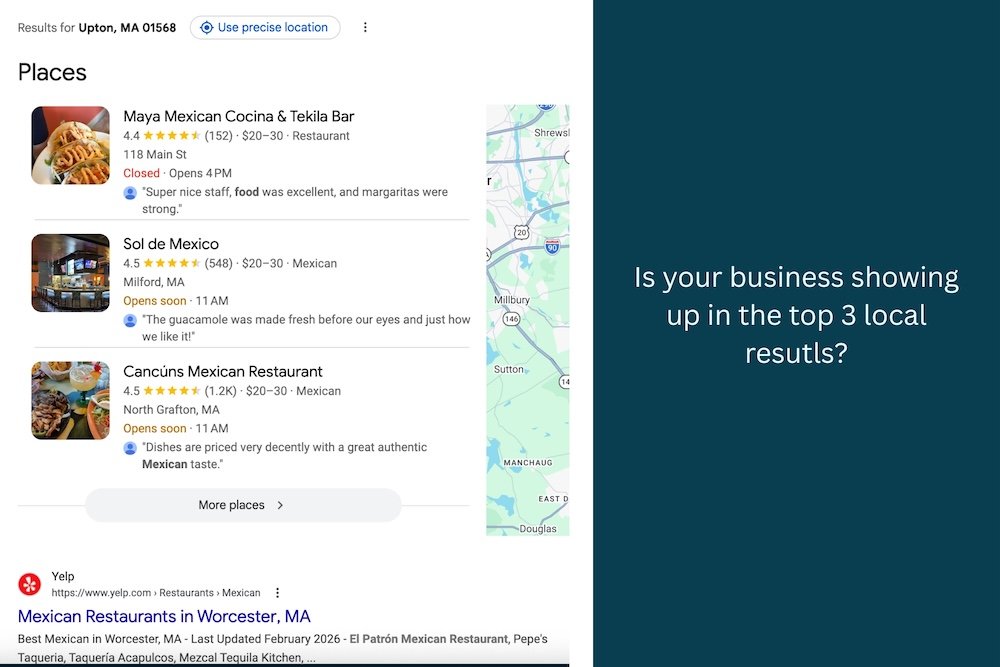
When someone in Worcester searches "plumber near me" or "best Italian restaurant in Framingham," how does Google decide which three businesses appear in that coveted Map Pack at the top of the results?
Understanding how Google ranks local businesses is the key to improving your visibility and attracting more customers in Central Massachusetts. While Google doesn't reveal its exact algorithm, they've given us clear guidance on what matters most, and local businesses that understand these ranking factors consistently outperform their competitors.
In this guide, I'll break down exactly how Google evaluates and ranks local businesses in 2026, so you can focus your efforts on what actually moves the needle.
This post is part of our local SEO series for Central Massachusetts businesses:
The Three Pillars of Local Search Rankings
Google has confirmed that local search rankings are based on three primary factors:
1. Relevance
2. Distance
3. Prominence
Let's break down what each of these means and how you can optimize for them.
Pillar #1: Relevance
Relevance is how well your business matches what the searcher is looking for.
When someone in Central Massachusetts searches "divorce lawyer," Google looks at your business information to determine if you're relevant to that search.
What Google Evaluates for Relevance:
Your Google Business Profile category:
This is one of the single most important ranking factors. If your primary category is "Family law attorney," you'll rank for family law searches. If it's just "Attorney," you're competing with every type of lawyer.
Example:
✓ Primary category: "Divorce lawyer" → Ranks well for divorce-related searches
✗ Primary category: "Lawyer" → Competes with all lawyers for all legal searches
Your business description:
The description in your Google Business Profile helps Google understand what you do. Be specific and comprehensive.
Keywords in your business name (carefully):
If your actual business name includes relevant keywords ("Worcester Plumbing"), that helps relevance. But don't stuff keywords into your business name; Google penalizes this.
Your website content:
Google crawls your website to understand what services you offer. Clear, detailed service pages improve relevance.
Your reviews:
The words customers use in reviews help Google understand what you do. If 10 reviews mention "emergency plumbing," Google knows you're relevant for emergency plumbing searches.
Services you list:
The specific services you add to your Google Business Profile help Google match you with relevant searches.
How to Improve Relevance:
✓ Choose the most specific primary category for your core business
✓ Add relevant secondary categories (up to 9 additional)
✓ Write a detailed business description using natural language
✓ List all your services in your Google Business Profile
✓ Create dedicated service pages on your website for each major service
✓ Use clear, descriptive content that explains what you do
✓ Encourage reviews that mention specific services you offer
For detailed guidance on optimizing your Google Business Profile: How to Optimize Your Google Business Profile for Central Mass Businesses
Pillar #2: Distance
Distance is how close your business is to the searcher's location.
This factor is straightforward but critical for local businesses in Central Massachusetts.
How Distance Works:
For "near me" searches:
When someone searches "coffee shop near me" from downtown Worcester, Google prioritizes businesses closest to their current location.
For city-specific searches:
When someone searches "coffee shop Framingham," Google prioritizes businesses actually in Framingham over those in nearby towns.
For neighborhood searches:
If someone searches "West Side Worcester restaurant," businesses in that specific neighborhood rank higher.
The Distance Challenge:
You can't change where your business is located. If you're in Northbridge and someone searches from Worcester, a Worcester business will have a distance advantage.
How to Optimize Despite Distance:
1. Expand your service area (for service businesses):
If you're a plumber serving multiple Central Mass cities, list all of them in your Google Business Profile service area.
2. Create location-specific pages:
Build dedicated pages for each city you serve with unique, location-specific content.
Example:
studio3elm.com/website-design-worcester-ma
studio3elm.com/web-design-northbridge-ma
3. Target location-specific keywords:
Optimize your website and content for specific Central Massachusetts cities and neighborhoods.
4. Get reviews from customers in different locations:
If you serve Worcester, Framingham, and Marlborough, reviews from customers in each city help you rank in those areas.
5. Consider additional business locations (if it makes sense):
Some businesses open satellite offices or co-working spaces to rank in multiple locations. Only do this if you genuinely operate from those locations; fake addresses violate Google's guidelines.
What You Can't Do:
✗ Fake your address (Google will suspend your listing)
✗ Use a P.O. Box as your primary address (not allowed for most business types)
✗ Hide your address if you have a physical location customers visit
✗ List an address in a city where you don't actually have a presence
For more on location targeting: On-Page SEO for Local Businesse
Pillar #3: Prominence
Prominence is how well-known and established your business is both online and offline.
Think of prominence as your business's reputation and authority. Google looks at dozens of signals to determine how prominent you are.
What Google Evaluates for Prominence:
1. Number and quality of Google reviews:
More positive reviews = higher prominence. This is one of the strongest ranking signals.
A Worcester law firm with 50+ reviews will typically outrank a similar firm with 5 reviews.
2. Review recency:
Recent reviews matter more than old ones. Businesses that consistently get new reviews signal they're active and serving customers now.
3. Average star rating:
While a 4.8-star rating with 50 reviews beats a 5.0 with 5 reviews, your rating still matters. Aim for 4.5+ stars.
4. Citations and directory listings:
The more places your business is listed online with consistent information, the more prominent you appear.
Key directories for Central Mass businesses:
Yelp
Yellow Pages
Better Business Bureau
Angi (formerly Angie's List)
Local chamber of commerce sites
Industry-specific directories
5. Backlinks to your website:
Links from other websites (especially local, reputable sites) signal prominence.
Quality local backlinks:
Worcester Telegram & Gazette featuring your business
Worcester Regional Chamber of Commerce member directory
Local business association sites
Sponsorships of community events
Guest posts on local blogs
6. Your website's overall authority:
Websites with strong SEO, quality content, and good user experience rank higher.
7. Social signals:
While not confirmed as a direct ranking factor, an active social media presence with engagement contributes to overall prominence.
8. Business age and consistency:
Established businesses with long histories and consistent information tend to rank higher than brand new businesses.
9. Click-through rate (CTR):
If your listing appears in search results but nobody clicks it, Google may lower your prominence over time.
10. User engagement:
How people interact with your listing matters:
Do they click for directions?
Do they call you?
Do they visit your website?
How long do they spend on your website?
How to Improve Prominence:
Get more Google reviews consistently:
This is the single most impactful action you can take.
Target: Aim for 2-5 new reviews per month minimum. Businesses with 40+ reviews see significant ranking improvements.
How to get reviews:
Ask satisfied customers directly
Send follow-up emails with review links
Make it easy with direct review links
Train staff to request reviews
For detailed review strategies: How to Optimize Your Google Business Profile for Central Mass Businesses
Build local citations:
Get your business listed (with consistent NAP [Name, Address, Phone]) on major directories.
Priority citations for Central Mass:
Google Business Profile (of course)
Yelp
Better Business Bureau
Yellow Pages
Facebook Business Page
Apple Maps
Bing Places
MapQuest
Local chambers of commerce
Industry-specific directories
Earn quality backlinks:
Focus on local, relevant links:
Get featured in local news (Worcester Telegram, MetroWest Daily News)
Join local business associations
Sponsor community events
Partner with complementary local businesses
Create shareable local content (guides, resources, data)
Optimize your website:
Strong on-page SEO contributes to prominence.
Key elements:
Fast loading speed
Mobile responsiveness
Quality, comprehensive content
Clear site structure
Good user experience
For detailed on-page optimization: On-Page SEO for Local Businesses
Maintain consistent business information:
Your NAP (Name, Address, Phone) must be identical everywhere online. Inconsistencies confuse Google and hurt prominence.
Engage with your Google Business Profile:
Active profiles rank higher:
Post weekly updates
Respond to all reviews (positive and negative)
Add new photos regularly
Answer questions in the Q&A section
Keep hours and information current
Build brand awareness:
The more people search for your business by name, the stronger your prominence signal.
Ways to increase branded searches:
Traditional advertising (local radio, print)
Vehicle wraps
Sponsorships
Community involvement
Word-of-mouth referrals
Social media marketing
How Google's Local Algorithm Works in Practice
Let's walk through how Google actually uses these three factors when someone searches for your type of business in Central Massachusetts.
Scenario: "Italian restaurant near me" searched from downtown Framingham
Google's process:
Step 1: Identify relevant businesses
Google looks for businesses with:
Primary category: "Italian restaurant"
Location in or near Framingham
Active Google Business Profile
Step 2: Apply distance filter
Google prioritizes restaurants closest to the searcher's location in Framingham. Restaurants 2 miles away rank higher than those 10 miles away.
Step 3: Evaluate prominence
Among the relevant, nearby restaurants, Google ranks them by prominence:
Restaurant A: 120 reviews, 4.7 stars, active profile
Restaurant B: 30 reviews, 4.9 stars, minimal activity
Restaurant C: 8 reviews, 4.2 stars, no recent reviews
Result: Restaurant A likely ranks #1 (highest prominence), even though Restaurant B has a slightly higher rating, because the review volume and activity are much stronger.
The Balancing Act:
Google balances all three factors. A business doesn't need to "win" all three to rank well.
Example combinations that rank well:
Business #1:
✓✓ Highly relevant (perfect category match)
✓✓✓ Very close to searcher
✓ Moderate prominence (15 reviews)
Result: Ranks well due to relevance + distance
Business #2:
✓✓✓ Highly relevant (perfect match)
✓ Farther away (10 miles out)
✓✓✓ Very prominent (100+ reviews, strong citations)
Result: Ranks well due to relevance + prominence overcoming distance
Business #3:
✓ Somewhat relevant (broader category)
✓✓✓ Very close
✓✓✓ Very prominent
Result: Ranks well due to distance + prominence overcoming weaker relevance
The Local Pack vs. Organic Results: Understanding the Difference
When you search for a local business, you see two types of results:
The Map Pack (Local Pack)
The three businesses that appear at the top with the map. These are ranked primarily by the three factors we discussed: relevance, distance, and prominence.
Map Pack is crucial because:
It appears above organic results
It includes a map showing locations
It displays reviews, ratings, and photos
Users can call or get directions with one click
Organic Search Results
These are the traditional "blue link" results below the Map Pack. They're ranked primarily by traditional SEO factors.
Organic results matter because:
"More places" link shows expanded listings
Users still scroll and click organic results
Strong organic ranking supports local pack ranking
You control more of the result (your full website)
The Strategy:
Optimize for BOTH:
Google Business Profile optimization → Map Pack rankings
Website SEO → Organic rankings
Strong presence in both = maximum visibility
Beyond the Big Three: Other Ranking Factors
While relevance, distance, and prominence are the primary factors, Google considers many other signals:
On-Page SEO Factors:
Title tags optimized for local keywords
Meta descriptions with location
Header tags with location and service keywords
NAP consistency across website
Location-specific content
Schema markup (LocalBusiness)
Internal linking structure
For complete on-page optimization: On-Page SEO for Local Businesses
Google Business Profile Factors:
Profile completeness (100% filled out)
Category selection (primary and secondary)
Business description quality
Attributes selected
Photos quantity and quality
Posts frequency and engagement
Q&A responses
Booking/messaging features enabled
Products/services listed
Review Factors:
Total number of reviews
Review recency (last 3 months matter most)
Review velocity (how fast you're getting new reviews)
Review diversity (reviews from different locations, demographics)
Keywords in review text
Review responses (responding shows engagement)
Review ratings (average star rating)
Review sentiment (positive vs. negative language)
Website Factors:
Mobile responsiveness
Page load speed
SSL certificate (HTTPS)
Domain age and authority
Content quality and depth
User experience metrics (bounce rate, time on site)
Local backlinks
Citation consistency
Behavioral Factors:
Click-through rate from search results
Calls from your listing
Direction requests
Website clicks
Time spent on your website
Engagement with photos
Interactions with posts
What's New in 2026: Recent Algorithm Updates
Google continues to refine its local search algorithm. Here are the most important changes and trends affecting Central Massachusetts businesses in 2026:
1. AI-Powered Search Results
Google's AI Overviews (formerly SGE - Search Generative Experience) now appear for many local searches. While these don't replace the Map Pack, they sometimes provide AI-generated summaries that pull from local businesses.
What this means for you:
Having comprehensive, well-structured content is more important than ever
Reviews and detailed service descriptions help you get featured in AI summaries
Quality over keyword density matters even more
2. Increased Emphasis on User Experience
Google is placing even more weight on user signals like:
How long people stay on your site
Whether they find what they're looking for
Mobile usability and speed
Actual engagement with your business (calls, directions, website visits)
Action item: Focus on creating genuinely helpful content and a smooth user experience, not just checking SEO boxes.
3. Video Content Gets Priority
Google Business Profiles with video content are getting more visibility in 2026. Videos in your profile can include:
Business tours
Service explanations
Customer testimonials
Behind-the-scenes content
Action item: Add at least one video to your Google Business Profile this year.
4. Sustainability and Business Attributes
Google has expanded business attributes to include sustainability practices, accessibility features, and more detailed service information. Businesses that complete these attributes thoroughly are seeing better visibility.
Action item: Review and update all available attributes in your Google Business Profile.
5. Review Response Quality Matters More
It's not just about responding to reviews anymore; the quality and personalization of your responses now impacts rankings. Generic "Thanks for your review!" responses don't carry the same weight as thoughtful, specific responses.
Action item: Take time to write genuine, personalized responses to every review.
How Rankings Change Over Time
Local rankings aren't static. Your position can change daily based on:
Factors That Cause Ranking Fluctuations:
New reviews: Getting new reviews can boost you overnight. Competitors getting reviews can push you down.
Google algorithm updates: Google regularly updates its local algorithm. Most updates reward higher quality, more engagement.
Competitor activity: If competitors optimize their profiles or get more reviews, your relative position may drop even if your absolute quality hasn't changed.
Searcher location: Rankings change based on where someone is searching from. You might rank #1 in Worcester but #5 in Framingham.
Search context: Google personalizes results based on search history, device, and other factors.
Profile updates: Changes to your categories, description, or other profile elements can impact rankings (positively or negatively).
Review changes: Negative reviews can hurt rankings. Removing old negative reviews or earning new positive ones can help.
Monitoring Your Rankings:
Check rankings regularly:
Weekly for primary keywords
Monthly for secondary keywords
From different locations (Worcester, Framingham, Marlborough)
On different devices (desktop, mobile)
Tools to track local rankings:
BrightLocal (best for local businesses)
Local Falcon (visual heat maps)
Whitespark
Moz Local
Manual searches (incognito mode, different locations)
Common Ranking Myths Debunked
Myth #1: "Paying for Google Ads helps local rankings"
Reality: Paid ads and organic rankings are completely separate. Google Ads don't influence your Map Pack position.
However: Google Ads can increase visibility while you work on organic rankings. Learn more: Do I Need Google Ads?
Myth #2: "More keywords in my business name = better rankings"
Reality: Keyword stuffing your business name violates Google's guidelines and can get your profile suspended.
Do this instead: Use your actual business name. Let your category, description, and content handle keywords.
Myth #3: "I need to be #1 in my city to get customers"
Reality: Being in the Map Pack (top 3) is crucial, but #2 and #3 still get significant traffic. Plus, organic results below the Map Pack get clicks too.
Focus on: Getting into the top 3, not obsessing over being #1.
Myth #4: "Social media links help local rankings"
Reality: Social signals are not a direct ranking factor. However, social media can drive traffic, engagement, and brand awareness, which indirectly supports SEO.
Myth #5: "I just need more reviews to rank higher"
Reality: Reviews are critical, but they're just one prominence factor. You also need strong relevance, good website SEO, citations, and engagement.
Best approach: Build prominence holistically, not just through reviews.
Myth #6: "Google ranks the best businesses first"
Reality: Google ranks the most relevant, nearby, and prominent businesses first. Quality and "best" are subjective. A newer restaurant with better SEO can outrank an older, possibly better restaurant that doesn't optimize.
Your job: Be great at what you do AND optimize your online presence.
Myth #7: "AI will replace the need for local SEO"
Reality: AI and automated tools are getting better, but local SEO still requires strategic human input. Understanding your market, creating quality content, and building genuine relationships can't be fully automated. In 2026, the businesses winning local search are those combining AI efficiency tools with human strategy and authenticity.
Action Plan: Improving Your Local Rankings in Central Massachusetts
Based on everything we've covered, here's your prioritized action plan:
Month 1: Foundation (High Priority)
Week 1: Optimize Google Business Profile
✓ Claim and verify your profile (if not already done)
✓ Choose the most specific primary category
✓ Add relevant secondary categories
✓ Write a comprehensive business description
✓ Ensure NAP is accurate and consistent
Week 2: Complete Your Profile
✓ Add all services you offer
✓ Upload 10-15 high-quality photos
✓ Add at least one video
✓ Set correct hours (including holidays)
✓ Complete all available attributes
✓ Enable messaging and booking (if applicable)
Week 3: Start Getting Reviews
✓ Create your review link
✓ Identify 10 happy customers to ask for reviews
✓ Send review requests
✓ Respond to all existing reviews with personalized responses
Week 4: Website Basics
✓ Optimize homepage title tag and meta description
✓ Add NAP to website footer
✓ Create or improve contact page
✓ Ensure mobile responsiveness
✓ Test and improve page speed
Month 2: Building Momentum
Relevance:
✓ Create/expand service pages with 400+ words each
✓ Add location keywords naturally to content
✓ List products/services in Google Business Profile
Prominence:
✓ Continue requesting reviews (goal: 2-5 new reviews/month)
✓ Start building citations (list business on 10 major directories)
✓ Create and post weekly Google Business Profile updates
Website:
✓ Optimize remaining pages' title tags and meta descriptions
✓ Add internal links between related pages
✓ Create first location-specific page (if applicable)
Month 3: Advanced Optimization
Prominence:
✓ Reach out for local backlinks (chamber of commerce, local blogs)
✓ Add LocalBusiness schema markup to website
✓ Continue review generation (should have 15-20+ by now)
Content:
✓ Launch blog with 2-4 local-focused posts
✓ Create FAQ section on website with FAQ schema
✓ Add more photos and videos to Google Business Profile
Citations:
✓ Build 10-20 more citations
✓ Audit NAP consistency across all listings
✓ Fix any inconsistencies
Ongoing (Monthly):
✓ Request 2-5 new Google reviews
✓ Respond to all reviews within 48 hours with personalized responses
✓ Post 4-8 Google Business Profile updates
✓ Publish 2-4 blog posts
✓ Add new photos and videos
✓ Monitor rankings and adjust strategy
✓ Check Google Search Console for issues
✓ Update content on at least one page
The Timeline: When to Expect Results
Month 1-2: Rankings may fluctuate as Google processes your changes. You might see small improvements.
Month 3-4: You should start seeing:
Improved Map Pack visibility
More profile views and clicks
Increased direction requests and calls
Better organic rankings for local keywords
Month 6: With consistent effort:
Solid Map Pack presence (top 3) for primary keywords
Ranking for multiple local keyword variations
Steady increase in local organic traffic
More customer inquiries from Google
Month 12+:
Dominant local presence
Ranking for competitive keywords
Significant organic traffic and leads
Strong review base (50-100+ reviews)
Remember: SEO is a long-term strategy. Consistency beats sporadic intense efforts.
Platform-Specific Considerations
Squarespace Businesses:
Squarespace makes many local SEO tasks easier:
Built-in mobile responsiveness
Automatic SSL
Clean URL structure
Simple SEO settings
What you need to add:
Schema markup (via code injection)
Strategic internal linking
Location-specific content
For complete Squarespace local SEO guidance: The Complete Guide to Squarespace for Massachusetts Small Businesses
WordPress Businesses:
WordPress offers more flexibility and plugins for local SEO:
Yoast Local SEO
Rank Math (schema builder)
WP Google Maps
Review plugins
Advantage: More control and customization options
Disadvantage: Requires more technical knowledge and maintenance
For platform comparison: Squarespace vs WordPress for Massachusetts Businesses
The Bottom Line: What Actually Matters in 2026
After everything we've covered, here's what you need to remember:
The Non-Negotiables:
Fully optimized Google Business Profile (correct category, complete information, regular activity)
Consistent review generation (2-5 new reviews monthly minimum, with personalized responses)
Strong on-page SEO (title tags, content, mobile-friendly, fast loading)
NAP consistency everywhere online
Quality, location-specific content on your website
Video content on your Google Business Profile (new priority for 2026)
Nice-to-Haves (But Still Important):
Schema markup
Local backlinks
20+ citations
Active social media
Regular Google posts
FAQ sections
What Doesn't Matter Much:
Exact keyword density
Domain age (if you have other factors strong)
Social follower count
Paid directory listings (most directories offer free listings)
Exact position (#1 vs #2 vs #3 in Map Pack)
The Real Secret:
There is no secret. Google's local algorithm rewards businesses that:
Clearly communicate what they do and where they are
Consistently earn positive reviews from real customers
Create helpful, location-specific content
Maintain accurate, consistent information everywhere online
Provide good user experiences
Adapt to new features like video and AI-powered search
Do these things consistently, and you'll rank well in Central Massachusetts.
Need Help Improving Your Local Rankings?
Understanding how Google ranks local businesses is one thing. Actually implementing all these strategies while running your Central Massachusetts business is another.
At Studio 3 Elm, I help local businesses throughout Central Mass improve their local search visibility through website SEO strategies (Squarespace and WordPress).
Ready to rank higher in local search? Schedule a free consultation to discuss your specific situation and create a customized local SEO strategy.
Related Resources:
Deep-dive guides:
On-Page SEO for Local Businesses: A Central Massachusetts Guide - Complete on-page optimization
How to Optimize Your Google Business Profile for Central Mass Businesses - Step-by-step GBP guide
The Complete Guide to Squarespace for Massachusetts Small Businesses - Platform-specific guidance
Quick reads:
How to Keep Your Local Business Showing Up on Google - Overview of local SEO
Do I Need Google Ads? - When to invest in paid vs. organic
Common Squarespace Design Mistakes - Avoid these UX issues
How to Make Your Squarespace Site Load Faster - Speed optimization
How to Optimize Your Squarespace Site for Mobile - Mobile best practices
About Studio 3 Elm
Studio 3 Elm provides web design and local SEO services for small businesses throughout Central Massachusetts. Based in Northbridge and serving Central Mass, Metro West, and surrounding areas, I specialize in helping local businesses improve their online visibility and attract more customers through search.
Contact me to discuss your local SEO strategy.